Buying a Business Security Camera System: Top Questions to Ask
1. Will we need to replace our current security cameras in order to get a new system?
Not always. Sometimes your current cameras can handle the need, and can be reconnected to a newer system.
Hybrid systems, with older and newer components combined, are fairly common, and can save on costs.
Often a new business security camera system, especially a cloud-based system, can offer great features, such as mobile access and alerts, but it comes with a catch: you have to use new cameras. Some of our cloud-based systems do not require new cameras. We recently converted a 10 year old system (including the older cameras) to cloud. We also can convert some analog cameras to cloud with encoders for that purpose. We can then add cloud analytics and add to the ease of searching video to that system.
It’s important to have the maximum choice of cameras. Camera quality and reliability affects the entire system. Having a choice on cameras now can keep you from being locked in – both now and in the future.
Ask us about the ability to use your current cameras with the new system you have selected.
2. How am I able to watch my business, especially during an emergency?
A video security system can help you protect against losses from both internal and external crime. How can this happen if no one is looking at the video feed continuously?
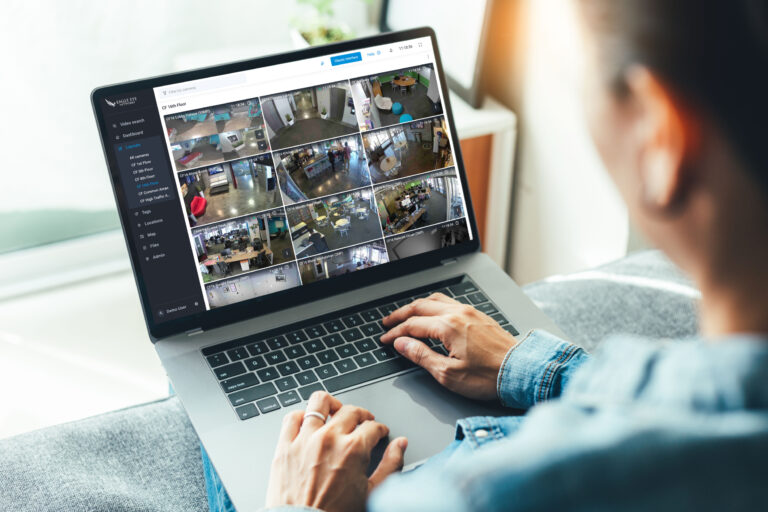
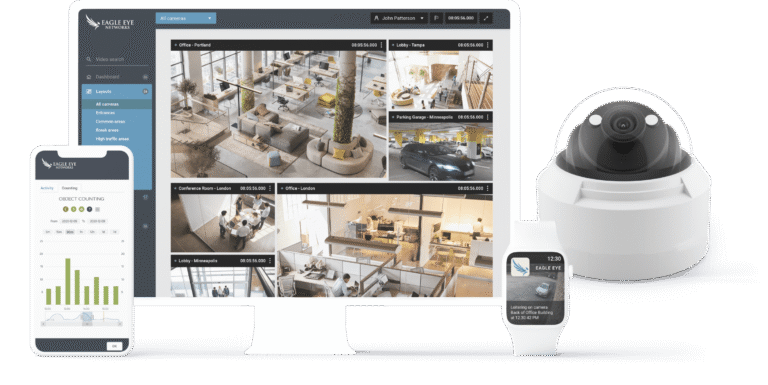
You can always know what’s happening on your premises with a reliable video management system (VMS). This allows you to view your camera footage anywhere you go, with a smartphone, tablet, or laptop, and to receive alerts when key events are happening. AI is also used in some of our systems to automatically detect when an incident is happening.
3. Do we need a cloud-based system, or on-premise video security system?
A cloud-based video security system means that the recorded video footage from security cameras is stored on remote servers, often hosted by a third-party.
Mission-critical video should be stored in a RAID configuration, (Redundant Array of Independent Disks). Cloud-based systems can perform this function.
Cloud-based systems come with annual fees, which can be weighed against the cost of ownership of a stand-alone system, which requires more initial investment in hardware. Since the video data for a cloud-based system is stored remotely, it is typically backed up by the cloud provider, instead of on additional in-house hardware.
Security is another factor to consider. Cloud-based systems are typically outbound traffic only, but also require more bandwidth to transmit the data.
Consider if you are required to do your video recording only on-premise. More and more criminals have learned to steal or destroy the video recorder equipment when they steal your property, which undermines the value of the system, and adds to the loss you suffer during a theft. Our cloud-based systems include secure cloud recording with redundancies, to prevent such hardware theft or tampering. Video recording that is on-site only also makes integrating the video from multiple sites into one system more challenging.
Some hybrid systems may have cloud recording, but also have some on-premise recording as needed. This can ensure that bandwidth is not an issue at particular times.
Can you move back and forth between the on-premise and cloud recording transparently?
In some hybrid systems, where some is stored on-premise and some in the cloud, reviewing is transparent to the user. Some systems also allow for mission-critical remote (cloud) storage for a few cameras that would be critical to have the footage for.
4. How can I know if there is system tampering or if a camera fails on our business security camera system?
Some of our business video security systems can include advanced camera tampering detection. Using AI, the system automatically alerts users in real-time by text or email if a camera is covered, moved, or has its view obstructed. This, along with other alerts, like line crossing and intrusion, are available for cameras connected to our systems.
5. What steps have been taken to eliminate security vulnerabilities in the video security system?
We can assist with eliminating security vulnerabilities in the video security system, and do so for many customers, depending on your specific needs.
